
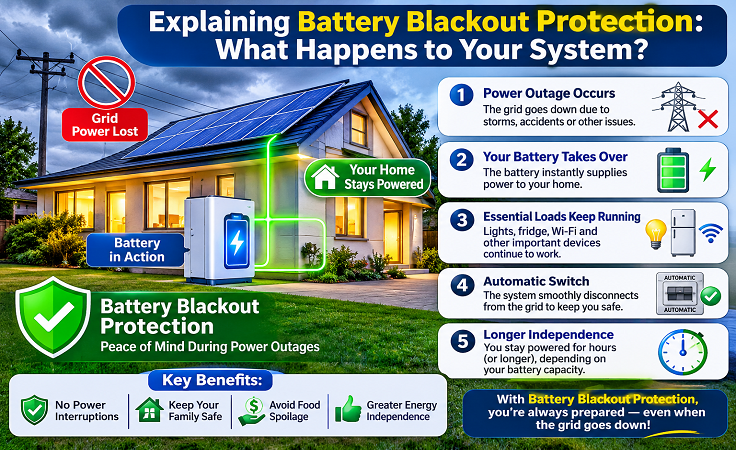
Blackouts are common in Maitland and Newcastle. It is very likely that you purchased your own solar battery system in order to be protected during blackouts. Let us review the operation of a solar and battery system and rehearse what to do in the event of a grid outage.
Why do solar systems switch off during a blackout?
One of the most common misconceptions about buying a solar system is that it will provide backup power during outages. Actually, your solar system is required by law to turn off as soon as the grid fails, even if the sun is shining and it is generating electricity.
Solar panels are unable to operate during grid outages due to a rule known as anti-islanding protection, which is required by Australian standards. When the grid goes down, a network electrician working on the power wires needs to make certain that no electricity from home solar systems is returning to the grid.
Grid-tied inverters include built-in sensing that quickly shuts down the system when it senses an outage, protecting both your system and the teams working on the power lines. You are not to blame. Your system’s inability to function during grid disruptions is not your fault; rather, it is a safety feature.
Do solar panels continue to produce electricity in the event of a blackout? Indeed, whether or not the grid is operational, solar panels themselves continue to produce electricity from the sun. What occurs after the panels is the issue, not the panels themselves. In order for the generated energy to be useful for your home, it must travel through the inverter; however, when the inverter shuts down, the energy has nowhere to go.
What actually lets a system keep running?
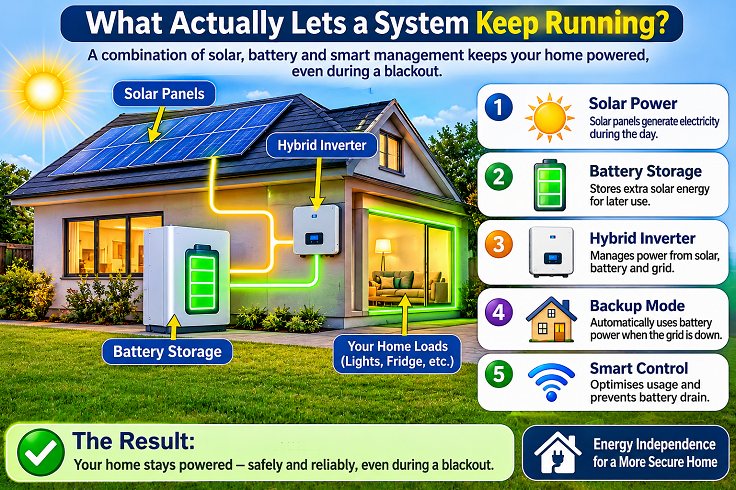
The inverter and design determine whether a residence is powered during a blackout or not. The term “grid-following” refers to a typical grid-tied inverter that operates using the grid as a reference and shuts off as soon as that signal vanishes during an outage.
Like a hybrid inverter, an islanding inverter is “grid-forming,” which means it can safely detach from the grid and provide steady electricity on its own.
However, not all solar and battery systems accomplish this. Here is an explanation:
- In the absence of a battery, a grid-tied inverter cannot island.
- The best option for backup capability is a hybrid inverter with a battery.
- In some arrangements, a retrofitted battery added to an existing grid-tied inverter may also become an island.
In the event of a blackout, how quickly does a solar and battery system flip over? The brand and setup of a solar and battery system will determine how quickly it activates during an outage. While some brands take up to 30 seconds to start working, others can flip over in a matter of milliseconds.
Hybrid vs. Retrofitted battery storage for blackouts
Adding a battery modifies the capabilities of your system, in contrast to the solar-only configuration. A battery can offer home backup depending on how it is set up, but only if blackout protection was taken into consideration during design and installation.
The primary distinction between AC-coupled (retrofitted) and DC-coupled (hybrid or integrated) solar systems is where the battery is located.
Separate from the primary inverter, retrofitted (AC-linked) systems feature an integrated battery inverter. This battery inverter can isolate the house and maintain power during a blackout. Whether or not the configuration was designed for it will determine whether or not it can continue charging from solar power while doing this. The battery runs out of capacity without the required hardware.
Hybrid (DC-linked) systems use a single inverter to control both solar and batteries, eliminating the requirement for a separate component to be instructed to continue operating. This implies that throughout the interruption, solar energy can continue to produce and charge the battery.
When going beyond the coupling discrepancies, there are additional factors to consider:
Integrity and dependability: All of your components are coordinated by a single unit in a hybrid system. This usually translates into a more predictable and seamless transition into backup mode. With two independent inverters, a modified system has additional potential sources of failure.
Power output: The amount of power your system can produce determines how much of the house you can run. A DC-coupled system can supply everything the inverter is capable of to run more than just the necessities, whereas AC-coupled setups can only actually support smaller loads with limited built-in inverter power output requirements.
Redundancy: One benefit of a retrofitted system is that it has two inverters; if one fails, the other might continue to function.
Running flat: Depending on the brand, some systems can be restarted and recharged solely by solar power, even when they are completely empty, while others could require grid power to start up again.
Which should you select: single or three-phase backup?
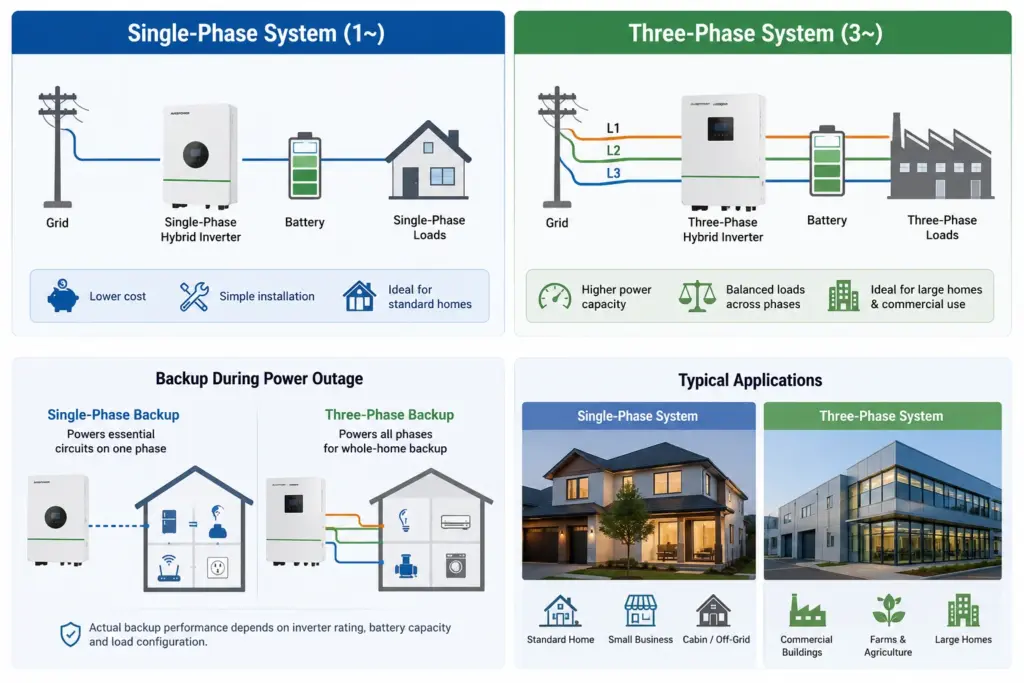
Determining whether you require single-phase or three-phase backup power is one of the most neglected aspects of obtaining blackout protection.
Larger residences and businesses in Australia use three-phase power, but the majority of homes use single-phase power. Larger customers with ducted air conditioners, electric car chargers, and pool pumps usually utilize three-phase since the electrical load may be divided across three different circuits.
The catch is this. Even when installed on a three-phase home, many battery backup systems only provide single-phase protection in the event of a grid breakdown. You will specify in your quote if you wish to back up all three phases with whole-home blackout protection. It is okay if your necessities, such as your refrigerator, lights, and internet, are on the same backup phase. A single-phase backup will make the appliances on the other two phases inoperable if your necessities are dispersed over three phases.
It is crucial to understand that this is not a mistake or flaw. It is set up as part of your system design to meet your needs and objectives.
Why The Draining Of Your Battery Is Quicker Than Expected
Both small and large battery system owners have the potential to overuse their batteries and exhaust them more quickly than they anticipate, particularly in the early stages of ownership.
If a phantom load steals all of your precious energy throughout the night, even a 30 kWh battery can run out well before dawn. Here are some things to look at:
Examine the battery app: Every battery we install comes with an app that allows you to view usage data, which can help you spot any consumption peaks or recurring loads based on usage history.
Recognize the priority of your load: Sorting your appliances into three categories will help you determine which ones are luxuries or necessities. Your battery’s charging time can be extended by removing superfluous loads.
Obtain monitoring at the circuit level: You can determine which circuits are using the most energy by keeping an eye on them. An EV charger’s CT clamp configuration, for instance, could assist in determining whether the EV is charging from the battery.
A blackout: What Happens to the Battery?
What precisely happens to the battery after a grid outage is resolved and electricity is restored? Does it simply start working again? Depending on the brand, this will change. Some batteries from different manufacturers start up again as soon as they are powered on, while others wait until they reach a specific percentage.
The Sungrow SBH series has what Sungrow refers to as a “solar black start,” which allows the system to restart itself as the sun rises and the solar panels are producing power, even if the battery is completely exhausted overnight during an outage. This implies that you will not need to do anything during lengthier outages—the machine should simply turn back on and begin charging.
The GoodWe ESA lineup functions similarly. With GoodWe’s all-in-one hybrid inverter and battery arrangement, you may adjust recovery thresholds and off-grid SoC lower limits through programmable parameters. These establish how much charge the battery needs before it automatically turns back on and how low it can go before output reduces to protect the battery.
For more information, consult the user manual that came with your battery. Some other brands might require manual intervention to restart.
Suggestions For Battery Owners with Blackout Protection
- Verify whether your backup covers all three phases or simply one if you are on three-phase.
- Recognize which circuits are backed up. Make sure you are aware of the appliances and power outlets on any vital circuits.
- Find out what happens to your battery during an outage, what the minimum charge is, and when it will begin to recover. Pay attention to your monitoring portal.
- Recurring spikes that do not fit your usage patterns should not be disregarded. As storm season approaches, be sure your battery is adequately charged.
Conclusion
All things considered, blackout protection can be a very useful tool for any home. For this reason, in order to guarantee energy security and the most features within your budget, your system should be developed around your use.
It is strongly advised that you get in touch with your local installation because the best blackout-protected solar and battery system will depend on your energy goals, budget, and usage patterns. Prime Goal Toowoomba would be happy to help you locate the best solar and battery packages with blackout protection if you are based in Newcastle and the Hunter.